Most Concordia College students and staff walk through the Integrated Science Center hallways without knowing prehistoric treasures are just feet away. The Elsie Welter Natural History Museum is located on the first floor of the ISC, Room 160.
Inside Concordia’s campus museum sit some of the lifelong works of Dr. Ronald Nellermoe, professor emeritus of biology.
“He’s spent almost his entire career teaching here, over 30 years,” said Dr. Joe Whittaker, associate professor of biology, of his colleague.
The impact of Nellermoe’s discoveries will span many more years.
Nellermoe began his career with the close relative of dinosaurs — birds. He started at Concordia as a professor of ornithology before his curiosity led him to something much older. He began bringing students in his class to the Hell Creek Formation in Montana to help with his search for fossils.
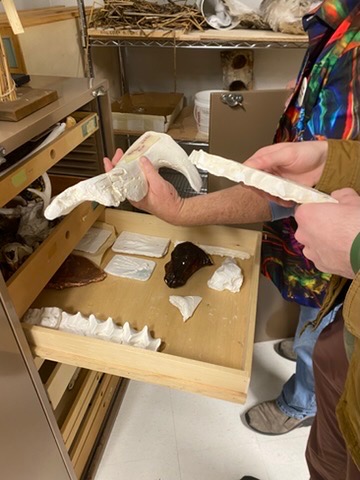
Over time, Nellermoe and his students have built what is now considered to be one of the most impressive Maiasaura (duck-billed dinosaur) collections, featuring specimens of all ages. His work was so significant that world-renowned paleontologist Jack Horner praised the collection.
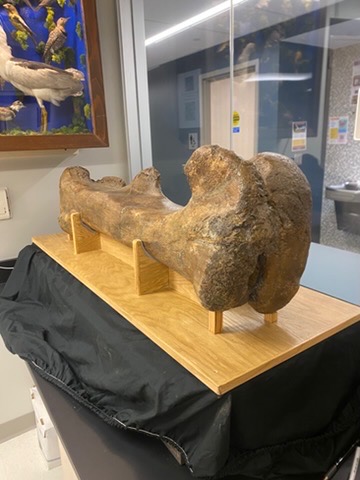
Other fossils that Concordia has for display:
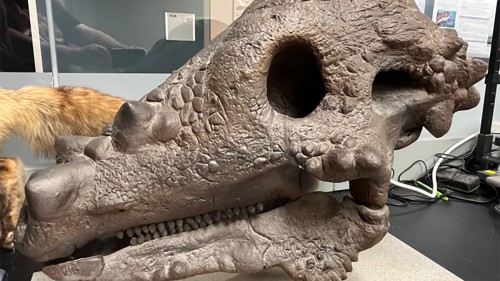
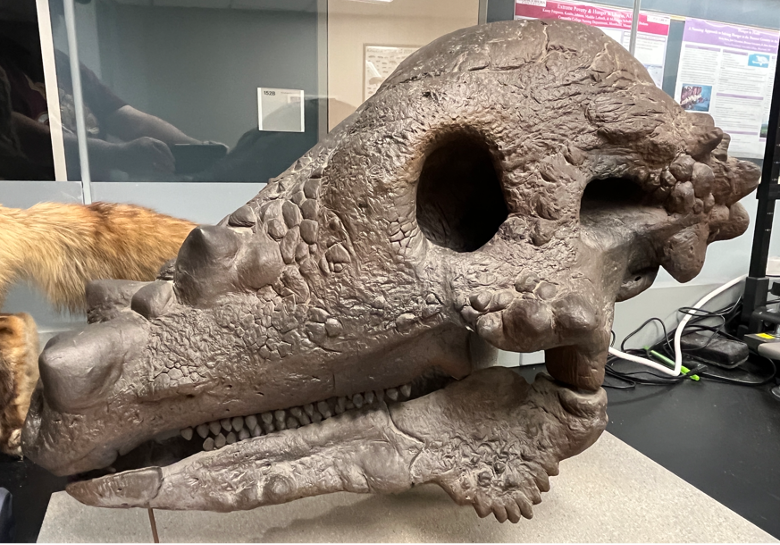
A Triceratops femur, a reconstructed Pachycephalosaur skull — which was partially sculpted by a student using only bone fragments and scientific estimates, a cast of an Edmontosaurus skull, fossils and casts from a newly identified Allosaurus species, and multiple fossilized teeth, jaws, and bones.
Many of the specimens Nellermoe and his students brought back were eventually transferred to the University of North Dakota, which continued the research the Concordia biologist had started.
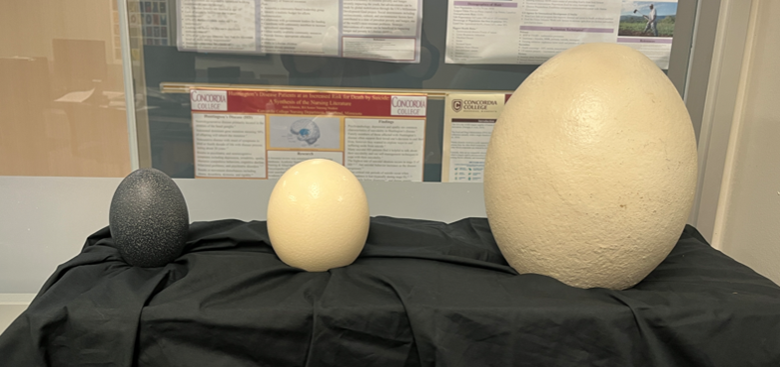
Among the museum’s artifacts is an extremely rare elephant bird egg. The elephant bird, native to Madagascar, stood up to 10 feet tall and went extinct just a few thousand years ago due to human hunting. It laid the largest egg of any species and is so massive that it is believed to be the largest single cell to exist.
“We kept the egg boxed up for years … until someone finally said, ‘How do you know there’s really anything in there?’” Whittaker recalled.
In order to protect the real egg, the museum keeps it safely stored, and a cast is displayed instead.
Though Nellermoe no longer leads the fossil digs, the impact of his work remains.
If you’d like to visit, design a display, or otherwise volunteer at the museum, contact Whittaker at jwhittak@cord.edu.
If you do happen to stop by the museum, make sure you submit your guess for bird of the week! This fun tradition was started by biology students and allows anyone to fill out a Google Form to guess the kind of bird species is featured in a picture in the museum.