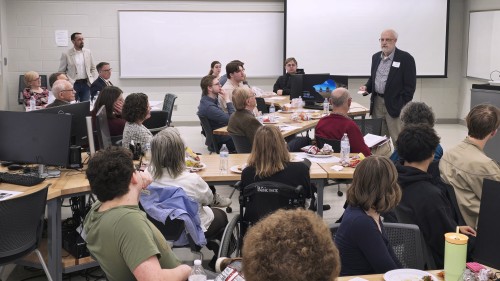
In honor of his groundbreaking work in health physics and foundational discoveries in neutron scattering, Concordia College has named an introductory physics laboratory after alumnus Dr. E.O. Wollan.
Wollan was recruited to work on the Manhattan Project by Enrico Fermi and Nobel laureate Arthur Compton, and established the protocols for measuring and controlling radiation during the startup of the first controlled nuclear chain reaction.
If Nobel Prizes could be awarded posthumously, Wollan would likely have been recognized with one in 1994, when his research collaborator, Dr. Clifford Shull, received the Nobel Prize in Physics. During his Nobel lecture, Shull credited Wollan for guiding him to the wonders of neutron scattering research and lamented that he didn’t live long enough to share in the honors.
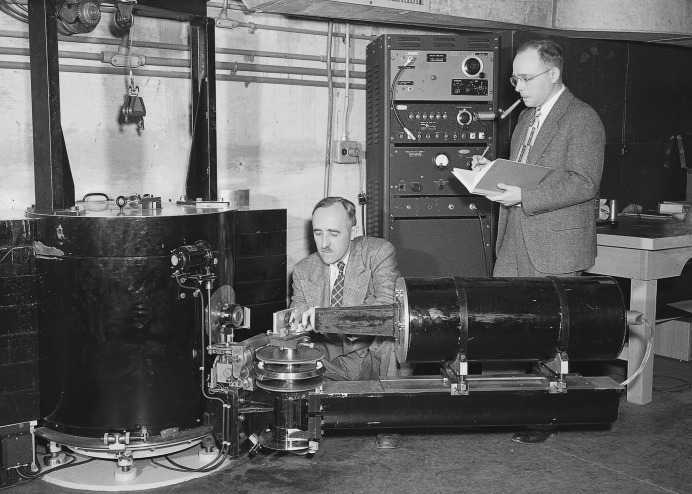 Dr. E.O. Wollan, left, and Dr. Clifford Shull, right
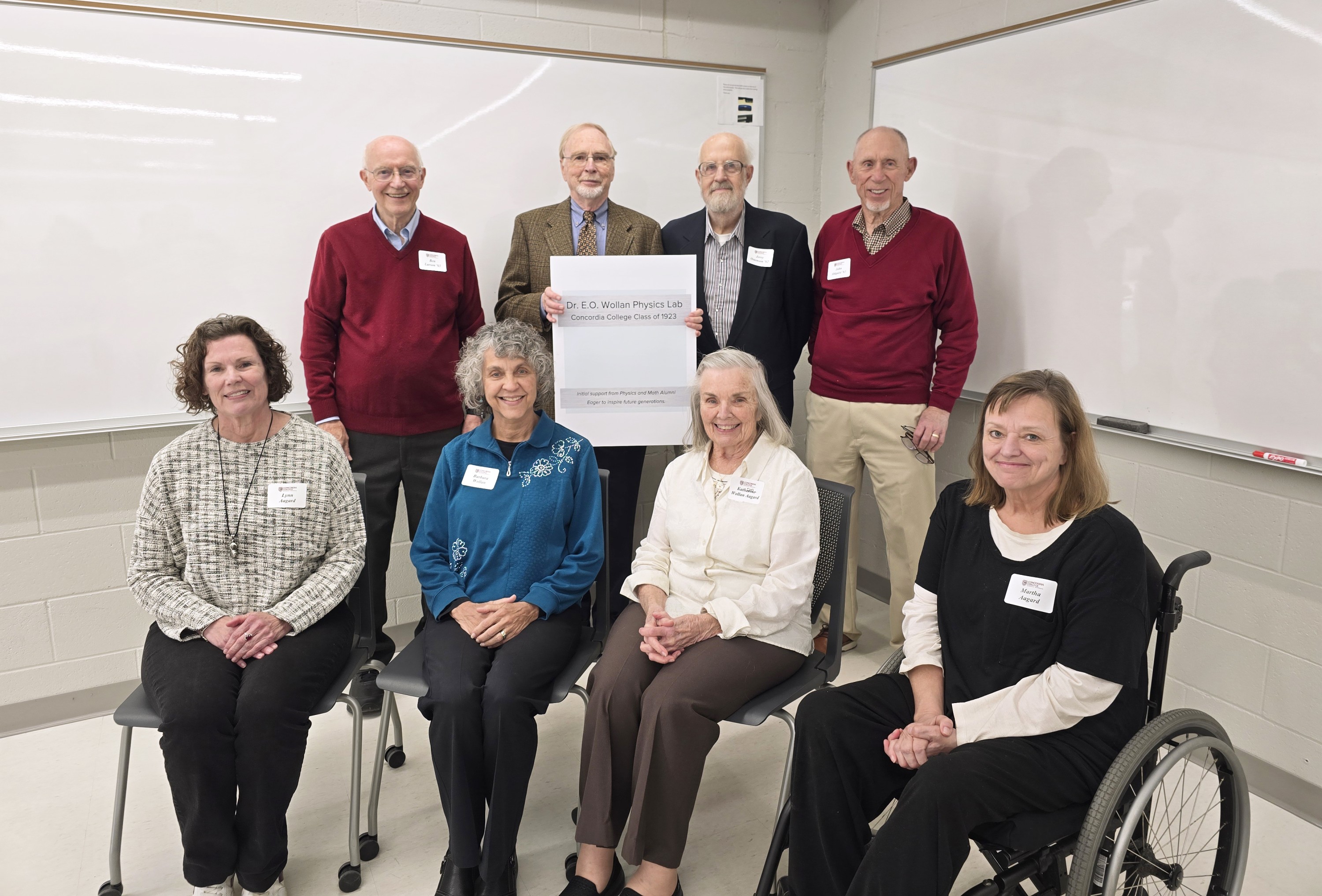
Concordia dedicated the lab last year with a ceremony attended by Wollan’s son and fellow physicist John Wollan and his wife Barbara, daughter Katheryn Wollan Aagard, and granddaughters Martha and Lynn Aagard.
Concordia alumni John Ahlquist ’63, Ben Larson ’63, and Jerry Ostenson ’62 reflected on Wollan’s work and shared how it intersected with their own professional paths. John Wollan spoke briefly about his father’s legacy, and both Concordia President Colin Irvine and Provost Susan Larson celebrated Wollan’s impact — and the significance of the laboratory for future generations of students.
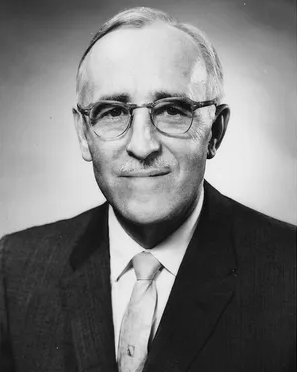 “We are grateful to all who joined us for this memorable occasion and look forward to the meaningful educational opportunities this introductory lab will foster,” said Dr. Luiz Manzoni, professor and chair of physics at Concordia.
Wollan graduated from Concordia in 1923 and earned his Ph.D. at the University of Chicago in 1929 under Compton.
During World War II, Wollan worked in the University of Chicago’s Metallurgical Laboratory as part of the Manhattan Project, leading the laboratory’s health-physics section and co-developing the film-badge dosimeter used to monitor radiation exposure.
His team established protocols for measuring and controlling radiation during the startup of the Chicago Pile-1 Reactor, and Wollan was among the small group of scientists present when the first controlled nuclear chain reaction took place.
After the war, Wollan designed and built the first instruments for neutron diffraction and, after recruiting Shull, the two made foundational discoveries in neutron scattering, a technique used to determine the atomic or magnetic structure of materials.
Their work was considered for the Nobel Prize in the 1950s but was passed over, a decision sometimes attributed to Cold War politics and the mistaken association of neutron diffraction with nuclear power.
Wollan received many other honors and awards over the years, including an honorary doctorate from Concordia in 1965.
The physics lab that now bears his name is not the first place to do so, either. Far, far to the south of just about everything on earth, in the Antarctic, lies Wollan Island, named for the Concordia graduate who used neutron diffraction to study the structure of ice.
More
- Study Physics at Concordia
- Shull and Wollan, Neutron Pioneers, from Oak Ridge National Laboratory
- Ernest O. Wollan, from the Atomic Heritage Foundation
 |
Concordia prof worked on Manhattan ProjectDr. Carl Bailey spent two years crunching nuclear physics equations on the Manhattan Project at Los Alamos, New Mexico. |