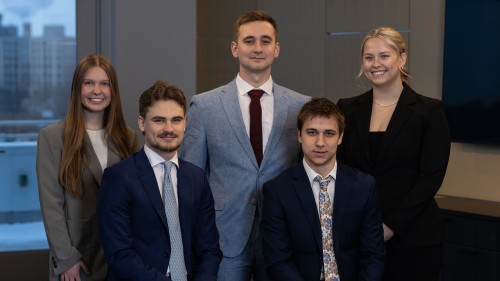
A team of Concordia College students recently presented their research and recommendations to healthcare industry leaders in Minneapolis as part of the nationally recognized Innovation Scholars program, an experiential learning initiative that brings liberal arts students into the complex world of medical innovation.
In February, Concordia’s 2025-26 Innovation Scholars team wrapped up four months of work by presenting its findings to leaders at Cytotheryx, a biotechnology company developing a reliable source of human liver cells for research and potential therapies. The project challenged students to tackle a real-world healthcare technology issue focused on treatments for liver disease.
Combining science, healthcare, and entrepreneurship, the multidisciplinary team researched the scientific, clinical, and business aspects of the emerging technology and developed recommendations for the company.
The Concordia team included:
- Hannah Corbin ’27, business management and business finance
- Annika Johnson ’26, biology (pre-med) with minors in chemistry, religion, neuroscience, and environmental and sustainability studies
- Ethan Lantz ’27, neuroscience and biology
- Brock LaTourell ’26, accounting and finance with a minor in coaching
“This opportunity was incredibly unique. As a business student, I was able to learn about the intersection of business and the biomedical industry, which is something I had never experienced before,” Corbin said.
LaTourell said the project gave him a firsthand look at the pace of innovation in healthcare.
“Having the opportunity to complete a business plan and research paper for an innovative biomedical company opened my eyes to the incredible developments in healthcare happening at this very moment,” LaTourell said.
He added that teamwork helped the group tackle complex scientific concepts.
“This project involved a lot of high-level science that I wasn’t familiar with going in,” he said. “I was very grateful to have a great team … and together we were able to make large obstacles manageable.”
Johnson said she was inspired by the opportunity and grateful to experience an interdisciplinary approach as she pursues a medical career.
“Concordia emphasizes creative problem-solving and teamwork, and those values were clearly reflected in our team’s work throughout the program,” Johnson said. “Developing the ability to collaborate with diverse teams is a skill that will be essential for me as a future physician.”
Corbin said the project changed how she approaches challenges.
“One of the biggest takeaways for me is that every field or major has the opportunity to make a positive impact,” she said. “Working with such a talented team pushed me to think about challenges from different perspectives.”
For Lantz, the project was more fun than expected. With a goal of attending medical school, he said it was incredible knowing that the treatments they were working on could help future patients.
“I’m very proud to have participated in this program with such an awesome group, and we could not have done it without our amazing faculty,” Lantz said. “They pushed us to do the best work we possibly could, and I truly believe that is what set us apart from other schools.”
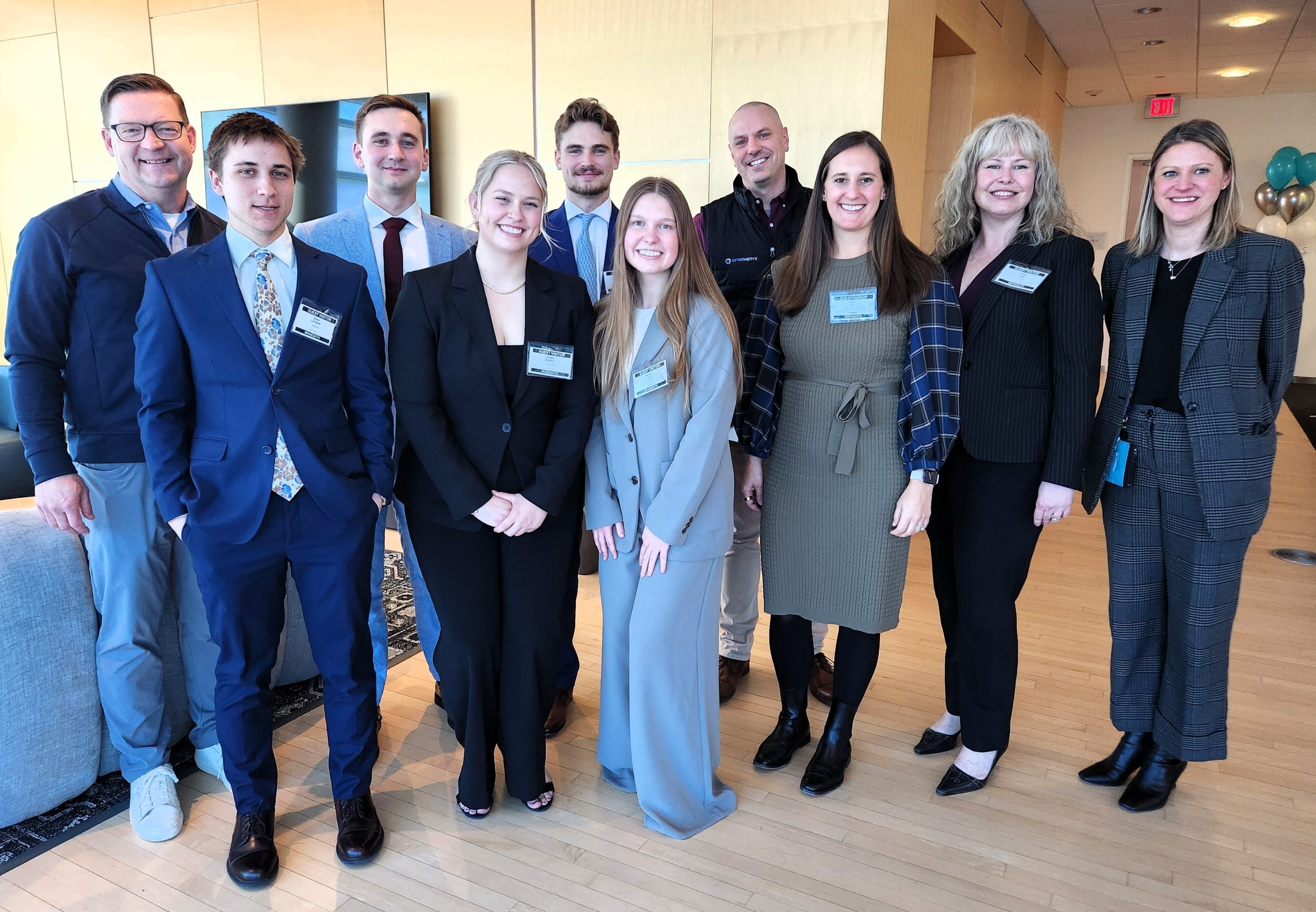
Several Concordia faculty and staff members served as campus mentors for the project, including Krys Strand ’96, director of undergraduate research; Emerson Towey, assistant professor of biology; Andie Greiff ’96, biology instructor; Allison Koster, former chemical safety officer; and Heather McDougall ’06, program director and assistant professor of entrepreneurship, as well as Charissa Quinlan ’13, senior director of project and program management at Aldevron, Fargo. The team was led by Williem Tieleman, an MBA student from the University of St. Thomas.
Concordia alumni also played important roles in the experience. Anna (Haugo) Argo ’11, chief business officer at Cytotheryx, served as the project sponsor, and Angie Benson ’02, director of learning and development at Coloplast, hosted the presentation site.
Celebrating Years of Innovation
The Innovation Scholars program — formerly known as the Mayo Innovation Scholars Program — engages student teams in translational medicine, the process of bringing medical discoveries “from the bench to the bedside.” Participants work with sponsors, including the Mayo Clinic, early-stage biomedical and healthcare companies, and NASA, to address real-world challenges in healthcare innovation.
The program is celebrating its 20th anniversary this year and will host a milestone celebration April 16 at the Science Museum of Minnesota in St. Paul.
Since Concordia first joined the program in 2006, 84 Cobbers have participated on multidisciplinary Innovation Scholars teams. Many alumni have gone on to careers in medicine, science, and biotechnology. Among them are Alex Ritter, now a senior scientist at Altos Labs in San Francisco; Corey Horien, a psychiatry research-track resident at the University of Pennsylvania; Elizabeth Quincer, a medical epidemiologist with the Centers for Disease Control and Prevention; and Ellia Dalzell, an administrative fellow at the Mayo Clinic.