Concordia students tackle real-world healthcare challenges in first case competition
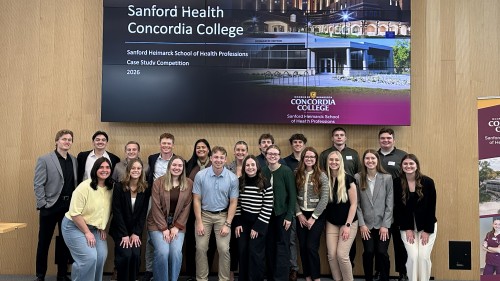
Concordia College students took on a pressing healthcare challenge this spring through a new partnership with Sanford Health, gaining hands-on experience solving real-world problems alongside industry leaders.
On March 31, the Sanford Heimarck School of Health Professions hosted its inaugural Student Case Competition, bringing together junior and senior students from across health disciplines. Over six weeks, five teams analyzed a complex case focused on workplace violence in rural healthcare settings.
Students developed 10-15 page reports with budgets and recommendations, then presented their solutions to a panel of healthcare executives.
“This is where real education happens,” said Dr. Steven Briggs, the chief medical officer for Sanford Fargo. “Experiences like this, where you’re solving real problems, are what prepare you for the field.”
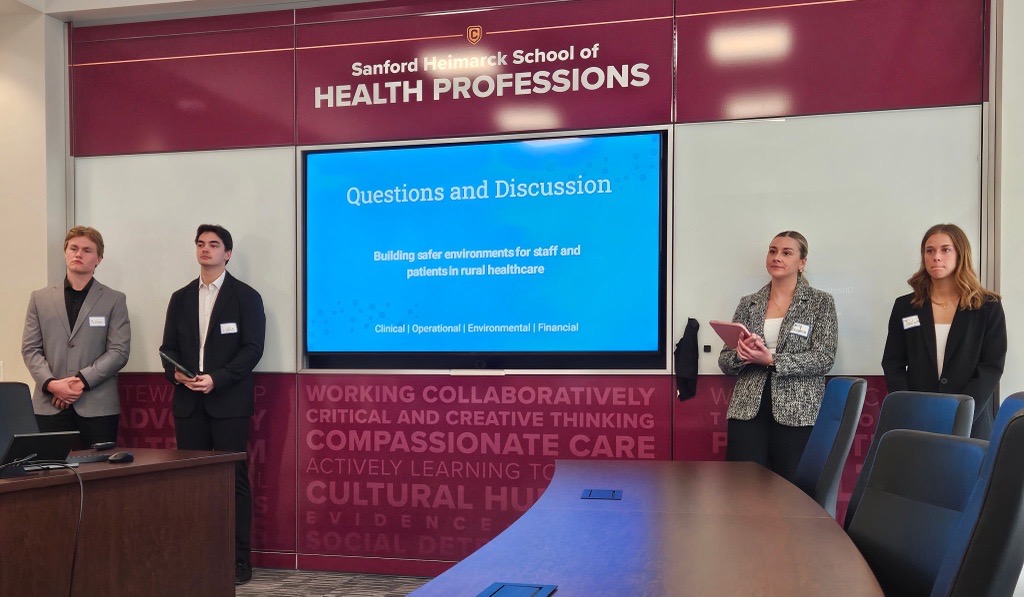
From idea to impact
The competition was more than a year in the making, led in part by students Ari Williams ’20 and Jayda Krikorian ’20, building on the original work of Emily Freier, who graduated in December.
For Krikorian, the opportunity fills a gap for undergraduate students.
“Experiences like this haven’t really existed here before,” she said. “It gives students a chance to engage with real-world challenges at a much deeper level.”
Real problems, collaborative solutions
The case pushed students to think beyond the classroom, using real data to address a complex issue affecting healthcare systems nationwide.
“Workplace violence is a significant challenge, especially in rural settings,” Williams said. “You have to find creative, realistic solutions.”
Krikorian added that the partnership created value on both sides.
“Students bring fresh perspectives, and Sanford brings real challenges,” she said. “Those ideas can lead to meaningful change.”
For Dr. Gwen W. Halaas, dean of the Sanford Heimarck School of Health Professions, that applied, interdisciplinary learning is essential.
“Students are working across disciplines to solve real problems,” Halaas said. “That’s where meaningful learning happens.”
Strong partnership, real results
The collaboration with Sanford Health shaped every aspect of the competition, from developing the case to evaluating student solutions.
Judges included Briggs, along with senior vice presidents Jana Hart and Jordan Ottoson.
“The students did an outstanding job,” Halaas said. “The level of thought and professionalism was exceptional.”
Sanford leaders noted they plan to bring ideas from each team back to their organization for further discussion. Awards were given to the top three teams, with Sanford providing monetary prizes.
Driven by purpose
Students chose to participate without earning academic credit, an indication of their commitment to the experience, said Kate Syverson, director of the healthcare leadership program at Concordia.
“They’re doing this because they see value in it,” she said. “That speaks to their leadership.”
Organizers see the competition as the start of a lasting program, with strong interest from Sanford leaders in continuing and expanding the initiative.
For students, the impact is immediate.
“This is the kind of work we’ll be doing,” Williams said. “It’s real, it’s challenging, and it matters.”
More
- Study at the Sanford Heimarck School of Health Professions at Concordia
- Study Healthcare Leadership | Exercise Science | Nursing | at Concordia