Accounting and finance double-major Gannon Brooks ’26 excels in soccer and with numbers.
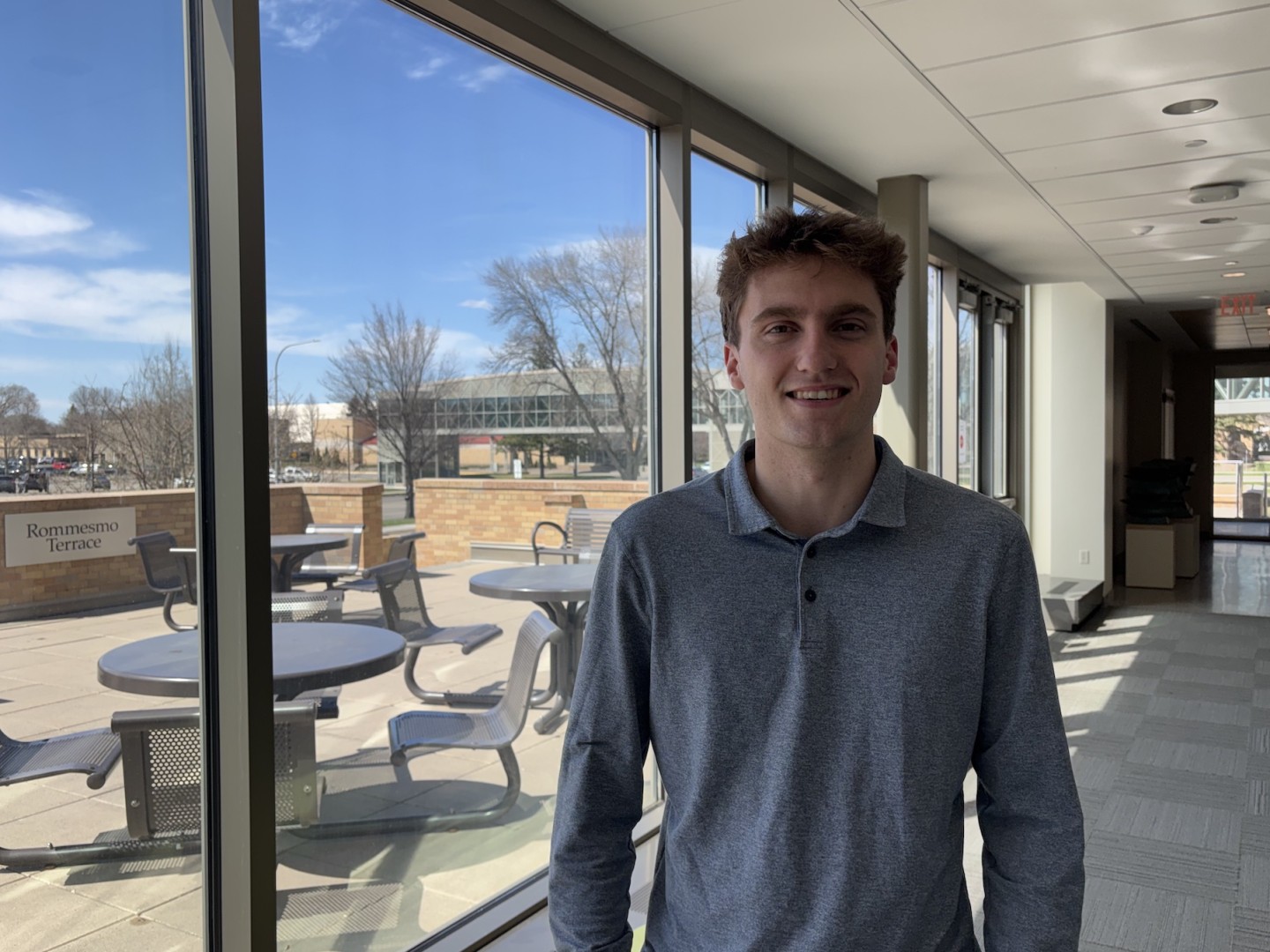
Gannon Brooks ’26 | Grand Forks, North Dakota
Majors: Finance, Accounting
Please introduce yourself.
My name is Gannon Brooks, and I’m from Grand Forks, North Dakota. The main pull to come to Concordia was soccer. I had a lot of friends who were on the Cobber soccer team. I was also really happy with the business school. I got involved in some extracurricular activities on campus, and I’ve enjoyed my time here ever since. I’m also double-majoring in finance and accounting.
How did you decide on finance and accounting?
I’ve always been a person that’s super involved with numbers. In school, I kind of struggled in the English portion and the reading portion, but I knew that I really liked math. And then coming into college, looking at some of the programs that were offered, I knew that the business school was where I wanted to be. So, I looked at accounting and finance. I originally chose accounting, and I did that for about a year and a half, and then I picked up the finance major later on. Starting out, I was originally planning on doing a Spanish minor but, once I added the finance major, I switched it up.
Do you have a favorite course that you’ve taken? Why is it your favorite?
Two come to mind right away. My last semester, I took Introduction to Geographic Information Systems (BIOL/ENVR 360), which uses ArcGIS. I learned a lot in that class, and I really like computers, so I enjoyed it more than I thought I would. My dad’s the city planner in Grand Forks, so it relates to that as well.
In the business school, probably my favorite course of all time at Concordia was Equity Analysis (FIN 304). I found that class to be super intriguing. There are core fundamental finance topics that were introduced in that class that were touched on earlier in Corporate Finance (FIN 303). I really enjoyed diving deeper into those topics and learning more about them.
If you were talking to a prospective student, what would you tell them is a reason to study accounting or finance at Concordia?
I would tell them to study accounting or finance because they may seem bland, but that’s just on the surface. Deep down, they’re truly very interesting. There are facets to accounting and finance that aren’t really seen by the naked eye. Once you look at them more with a microscope, and you’re able to analyze, you can see a lot. There are many different career fields that are open to someone with a degree in accounting or finance. They’re very challenging as well. Being able to challenge yourself is huge, especially in your development beyond Concordia.
The case studies that we worked on were super relevant.
What are the benefits of taking classes in the Offutt School of Business?
The applicability of the classes. The case studies that we worked on were super relevant and were based on real scenarios that have happened in the business world, scenarios that are good things to learn from.
Secondly, the small class sizes were a huge benefit for me. That was a big thing when choosing Concordia, being able to have such a personal connection with the advisors and being able to ask questions after class. You don’t really feel awkward about raising your hand and being open to asking questions, especially with professors who are open to answering those questions. They also want to help develop you as a person, especially beyond your academic life.
What leadership opportunities have you had on campus?
I’ve been a captain on the Cobber men’s soccer team since the end of my sophomore year. I was also a treasurer and fundraising coordinator for Habitat for Humanity on campus, and that was fun. I really enjoyed my time with that. Additionally, I was on SAAC (Student Athletic Advisory Committee) for a semester. We had a leadership council on our soccer team as well, and I helped lead and worked with the coach in that aspect.
What do you enjoy most about playing soccer at Concordia?
It has to be the guys that I play with. I’ve developed deep connections with a lot of the guys on the team and just being a leader for them. Many people will come to college, and they’re very unsure about what they want to do, especially in academics. I found that a lot in my past four years and being able to guide them provides value for me, and they’re people who I really care about. So, both of those things tied together.
How do you balance athletics, academics, and other responsibilities?
It’s just got to be discipline. Scheduling is something that I learned probably last year, or at least to the full extent that I understand it now. Being able to have the discipline in what you’re planning to do during these times in the week is super important, and it’s also very rewarding once you’re able to achieve it.
Can you tell me about your experience as a Barry Scholar?
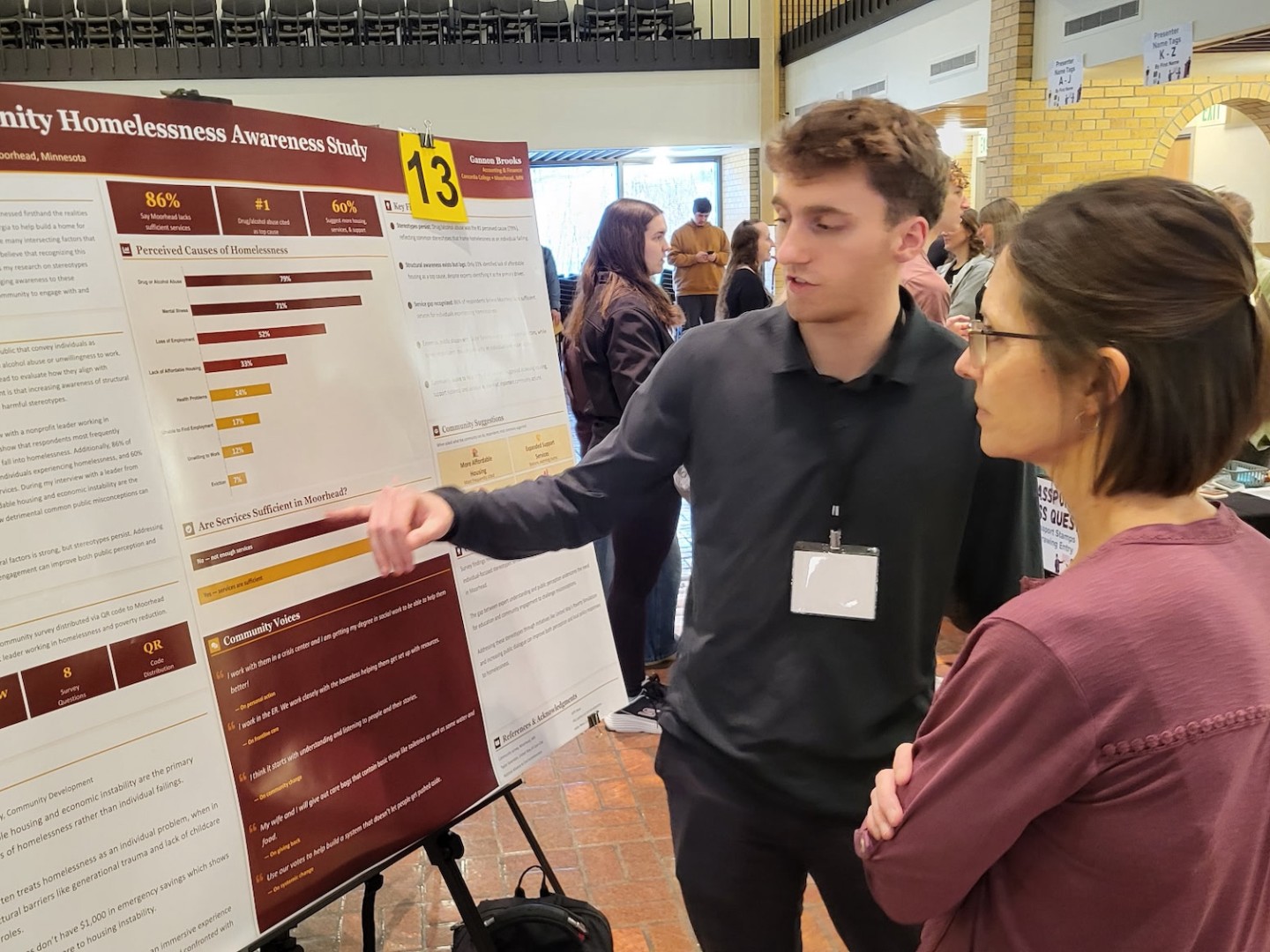
My research focuses on stereotypes toward homeless populations, and then eventually educating students about those stereotypes, which I presented at COSS (the Celebration of Student Scholars). I did a survey in the community to gauge how people here perceived the homeless population and what the main stereotypes might have been. And the survey actually did very well. They were given the option to choose three out of about 10 options. Seventy-nine percent of individuals rated drug and alcohol abuse as the main reason that people fall into homelessness. I interviewed Taylor Syvertson, the director of community impact at United Way of Cass-Clay. She said that was just not the case. The survey showed that a lot of individuals are blaming homeless people for their individual reasons and their individual failings when, in reality, it’s more systemic. That’s the main highlight of the entire survey and the research that I’ve done, and I really hope to educate students about that.
What advice do you have for students who are interested in becoming a Barry scholar?
You have to find something that you care deeply about. I actually chose my topic because, right before I did my proposal and presentation, I had just gotten back from a trip to Georgia with Habitat for Humanity. Your topic has to be something that you care deeply about and something that you want to see change in, and something that you want to tell other people about. Without that, it’s hard to have the motivation.
Have you had any mentors at Concordia?
One of the biggest mentors for me was probably Dr. Robert Gholson. He’s one of the new finance professors. He and Dr. Angel Carrete are super open to answering questions regarding finance, and there have been plenty of times where I’ve stayed after class longer than I should have just talking to them about things. Dr. Gholson was also our advisor for the CFA (Chartered Financial Analyst) research challenge that we did, and that was something that really helped develop my understanding of finance and, once again, the real-world applicability of it. So, I would say that Dr. Gholson has been a mentor to me. He’s super open to questions and always willing to help.
Tell me about your internship experiences and what you have learned from them.
I was an accounting intern at a local HVAC company. That was during my sophomore year. I was there for about six or seven months, and I learned a lot. I did some journal entries, bank reconciliations, and reconciling of their insurance billing. That was a huge part of my role. I spent time working in Excel, and that was where I came to understand the basic functions of Excel. I have grown since then, both in classes and as an individual.
Then, directly after that internship, I got a role at Red River Financial, which is a financial planning firm in Fargo. There, I set up investment accounts, enter ledgers for insurance policies, and work with the financial planning software. I’ve learned about that, and I’ve gotten pretty good at it, which I’m happy about. I also make agendas for clients. So when one of the planners goes into a meeting, I have everything ready for them regarding the client situation, insurance, investments, and taxes. I do some business valuations using business valuation software, which has probably been the most important part of my job. I really do enjoy just looking at financial statements and being able to take value from what is in them.
How did you hear about Concordia, and why did you decide to attend college here?
I first heard about Concordia when the guys that I was playing with in club soccer who were older than me first made their college commitment posts. I was looking to see where they were all deciding to go, and I saw that a lot of them chose Concordia. That was what piqued my interest and made me start to look online at some of the programs that Concordia had to offer, and then eventually narrow it down to the business school programs because I knew that I wanted to be around numbers, and accounting really fit that for me.
Concordia was sticking out to me for most of my senior year. November or December of my senior year of high school was when I finally was like, yeah. Why would I not attend Concordia? I had actually already come on a visit here and stayed with one of my friends who was on the Cobber soccer team, and they were telling me about the business school and how great it was. I was pretty much already sold then but, during that visit, it was probably a defining moment for me because I was able to actually go on campus and be in the business school.
What is some advice you would give to a first-year student?
I would say to one, get the planning done. Once you figure out your major, and once you have that narrowed down to what you want to do, still try to take other courses. It’s important to be able to learn about different things and also challenge yourself a little. I took a history class just because I had the extra credits available, which was similar to why I took the Geographic Information Systems course. I knew that I liked computers, and pushing myself to go out of my comfort zone is really important. That’s important for incoming students as well, especially when you’re coming into an environment that’s a little uncomfortable already. Being able to push that comfort zone a bit is huge and does a lot for you down the road that you might not realize right now.
What advice would you give to a high school student who’s considering Concordia?
Come to Concordia. The people here and the students are extremely engaged in campus activities and nice to one another, and they’re willing to do a lot for each other. That’s something that you’re not able to find on every college campus. Also, the experience that you can get from the professors in the smaller class sizes is something that you’re not going to be able to get at every college. Other advice I would give is to go out of your comfort zone, similar to those incoming freshmen, because you learn a lot when you’re able to swim in the deep water. And that’s important.
Published May 2026