Outstanding International Business Student Award recipient Cassandra Sternitzky ’26 shares how she combines her interests in Chinese and business.
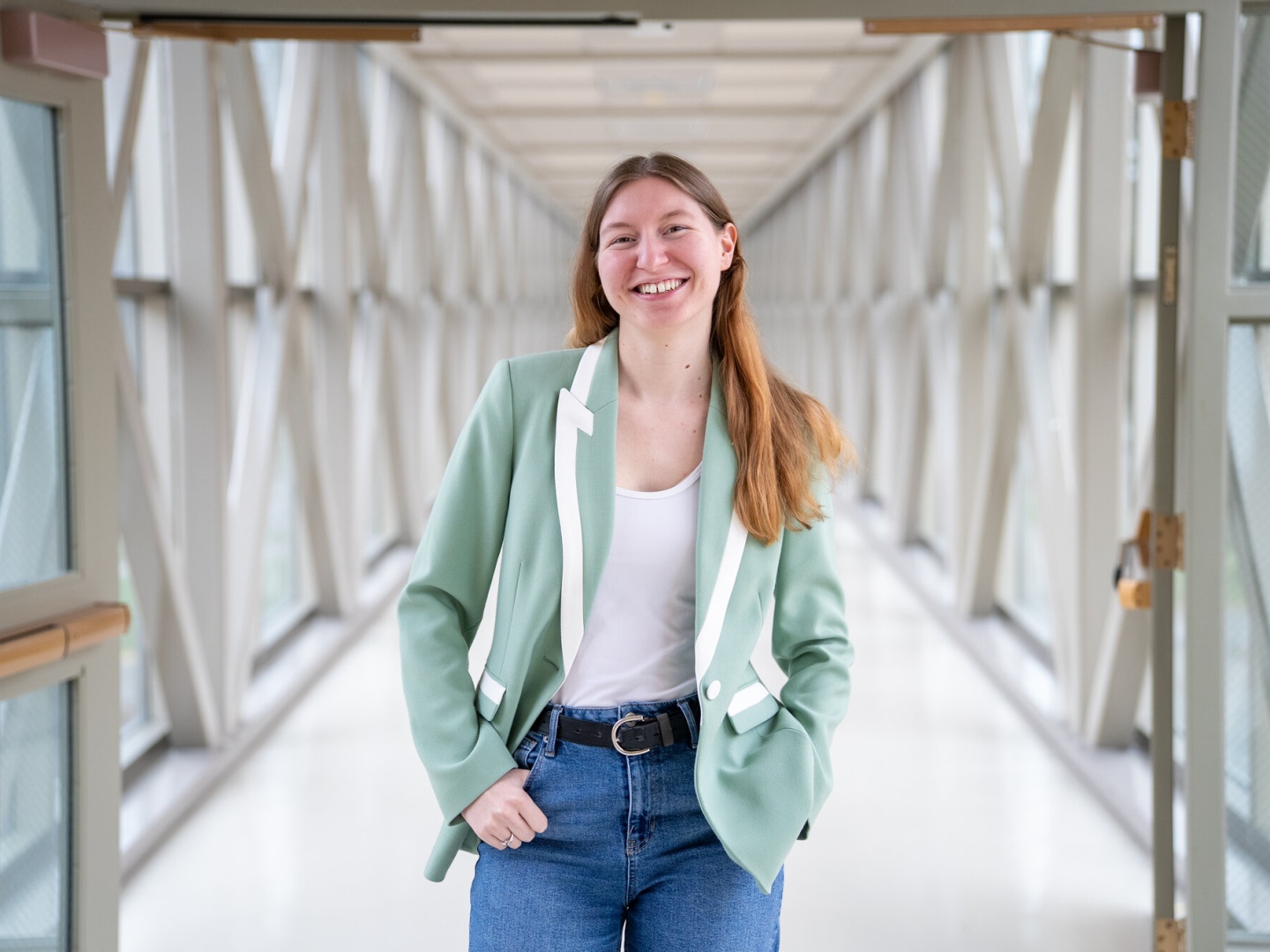
Cassandra Sternitzky ’26 | Audubon, Minnesota
Majors: Chinese Language and Cultures, International Business with concentrations in Finance and Economics
Please tell us about yourself.
I just graduated with a double major in Chinese and international business with concentrations in economics and finance. I am originally from Audubon, Minnesota. As far as my career goals, I am definitely looking for something in supply chain management or logistics. I find that highly interesting. And, of course, with my Chinese background, I would sure hope to work on something with China.
How did you hear about Concordia, and what was your deciding factor to attend?
I heard about Concordia from one of my advisors in high school, and she was asking me if I would like to do PSEO (the Postsecondary Enrollment Options program). In order to do that, you need to choose a school that is in state. Because PSEO students are also in high school, she was thinking someplace close. One of the main reasons I wanted to do PSEO was to take Chinese. My advisor heard that and said there’s a school only an hour away, let’s do that. Concordia having the Chinese program was definitely the deciding factor. But then, after a year of doing PSEO, I decided to stay here because it has the additional programs that I wanted, like international business, and has concentrations in economics and finance.
How did you decide on your majors?
I originally thought I might be an accounting major, but after I found Chinese and knew that was one of the majors I was definitely going to choose, I thought international business seemed more compatible with the types of things I wanted to be doing. So they kind of went hand in hand that way.
What was your favorite course that you took at Concordia?
The first one is a course I took in my final semester, which is Global Supply Chain Management with Dr. Marcia Scarpin. I find supply chain management incredibly interesting. Watch when you go to a store and buy something and think about how you made that one decision, and then know that there is a whole network of people, places, and transportation systems — all these connections work together to get you one product on the shelf. And then think about it as a whole store, and there are hundreds of communications and networks and people and decisions that have been made to get this one store looking the way it is.
The other course was U.S.-China Relations, taught by Dr. Rebecca Moore. I found the class highly interesting because it was more of a politically sided class. So even though we try to maintain some neutrality and look at both sides when we’re talking about politics, with business, we tend to focus on the monetary side or the connections you can make. In reality, there’s also this political factor that’s coming in from the larger governing bodies. For example, with the U.S. and China talking back and forth, there are going to be regulations that change or factors that are pushing and pulling all the time. It taught me to look at business from a new perspective, not just how much money you can make off the business with different connections or through trading, but also how to know when it’s the right time to make the connection or how you approach the situation when there are high political tensions. So that class in and of itself was very interesting, but also as it relates to business.
How would you say that the Offutt School of Business prepared you for your career and life after college?
One of the programs that is really helpful is the internship requirement for international business majors and for some other majors as well. I had a wonderful internship with Thomas & Reed, and it has set me up with real-life experience. Being able to have both an advisor and mentors who are helping you not only find an internship, but also reflect on your internship while taking it, is very beneficial.
I was also a Hollstadt Business Leadership mentee. That is a really great way to build connections and learn about being a leader, sometimes through active leadership, but through other methods as well: through quiet power, communication, or just doing an excellent job in general, even if you don’t necessarily have a team all of the time to lead.
What else were you involved in on campus?
Besides being a Hollstadt Business Leadership mentee, I was also president of the Chinese Club. That was a really great experience, more from the leadership aspect as well, even though it’s a small club. Being able to learn how to lead a team, I would say it’s easier with a rather low-stakes environment because clubs fluctuate based on events you hold, how many people you have, all that kind of stuff. Also, I found Chinese Club incredibly fun because it’s something that you don’t really get often. My team was wonderful — shoutout to the Chinese Club board because you guys make it happen.
It’s also a really great thing to add your resume. You learn so much about how to hold events or how to logistically plan a hundred little details that you maybe wouldn’t have originally thought went into every event. Between learning how to lead and manage a team and learning how to run an event, all those things are wonderful experiences that are both fun and educational.
Can you share a little about study abroad experience?
I spent a semester in Zhuhai, China, at an English-speaking school. The way that the program works is that you get to live with a national. My roommate was from China and was learning English. You get to take all of your classes in English, except for the higher-level Chinese courses. I took International Marketing Foundations and Foundations of Chinese Economics. It’s really interesting from the standpoint of getting to travel, but also getting to learn from a different perspective. When taking a class like Foundations of Chinese Economics, learning from their perspective is something I don’t get to do often. And then to take that back here to classes, and be able to reference what I learned and how I learned about it from a different perspective, was valuable. I also got to travel to Shanghai, Beijing, Chengdu, and Xi’an while I was there.
Do you have any advice or tips for students who are interested in a study abroad program?
Well, the first thing is 100% do it. If you can, study abroad. It’s a good experience. I mean, not everything is going to go perfectly. It just won’t. That’s the reality of life. But it teaches you many valuable skills, and not necessarily the same ones for every person.
For me, it taught me a lot more about how to do it scared. I was terrified the whole time I was in China that I was doing something wrong, that I wasn’t doing the appropriate cultural things, that I was going to fail a course or get stuck at an airport. For me, it taught me that it doesn’t matter how scared I am. I have to start doing it and see what happens. But I know for some of my other friends who have also studied abroad that it’s more of a social development where they’re learning to talk with people from other countries in a way that’s beneficial for both of them. Some people have more of an academic experience where they’re focusing on specific classes that they find really interesting.
It’s very important that if you can, you should do it, because you will find out something new about yourself. It depends on what kind of experience you have.
They were invested in me understanding the answer.
How did the faculty in the Offutt School of Business impact your studies and help you accomplish your goals?
In general, every faculty member in OSB is super approachable, which I always found to be very nice. I knew that if I needed to go to a professor and ask them a question, they weren’t going to look down on me for having to ask a question and, not only did they answer the question, but they were invested in me understanding the answer. That is something that can be a little challenging to find. Not only someone who will teach it to you, because there are an infinite number of people who could teach you something, but it’s finding the people who want to see you learn it and who want to see you succeed after learning it.
Dr. Jiani Jiang is a really great example of this. I had a couple of classes with her, and I’ve gone to her with questions several times about marketing, but also about general stuff like internships. Even if she didn’t know the answer to my questions, she was always very willing to help in any way that she could. Whatever capacity the professors can help, they will help.
How have your experiences in class connected you with leadership roles on campus?
Once a professor gets to know you in class, typically, they see your hard work and places you would be a good fit. That’s how I got recommended to the Hollstadt Business Leadership program. I started getting recommendations for internships. The professors see their students in class and see them for their strengths and weaknesses.
I’ll use an example from Dr. Anne Mocko, who is a religion professor and who taught my Religions of East Asia class. One of the topics was Confucianism. We discussed how there’s this idea of teaching and that there’s a senior role (professor) and a junior role (student). There’s some level of respect and listening to the advice that the people with more experience have to offer. But then there’s the additional part, which is best captured in these words, that the senior’s role is to teach you how to be a better person. And that is something the professors here at Concordia do an excellent job with. They’re not just providing you with knowledge. They are looking for ways that they can help you become a better person.
What advice do you have for students starting out on campus?
I would emphasize the importance of joining clubs, whether it’s the Chinese Club or other clubs. Having one club where you go to events often is very important, especially if you’re not in a sport or in some sort of mentorship program. Having a club can be a really easy way to stay connected and have a community on campus. Also, even if you’re only going occasionally, I would definitely consider trying to be on a board if you can because you don’t have to be a club president to learn things. It can be a really great opportunity to learn how to build connections in a meaningful way and to bring more life to campus.
Published May 2026