As the recipient of the 2025 English summer research fellowship, a choir project gave Jordon Perkins ’27 the idea for his research on documentary poetry.
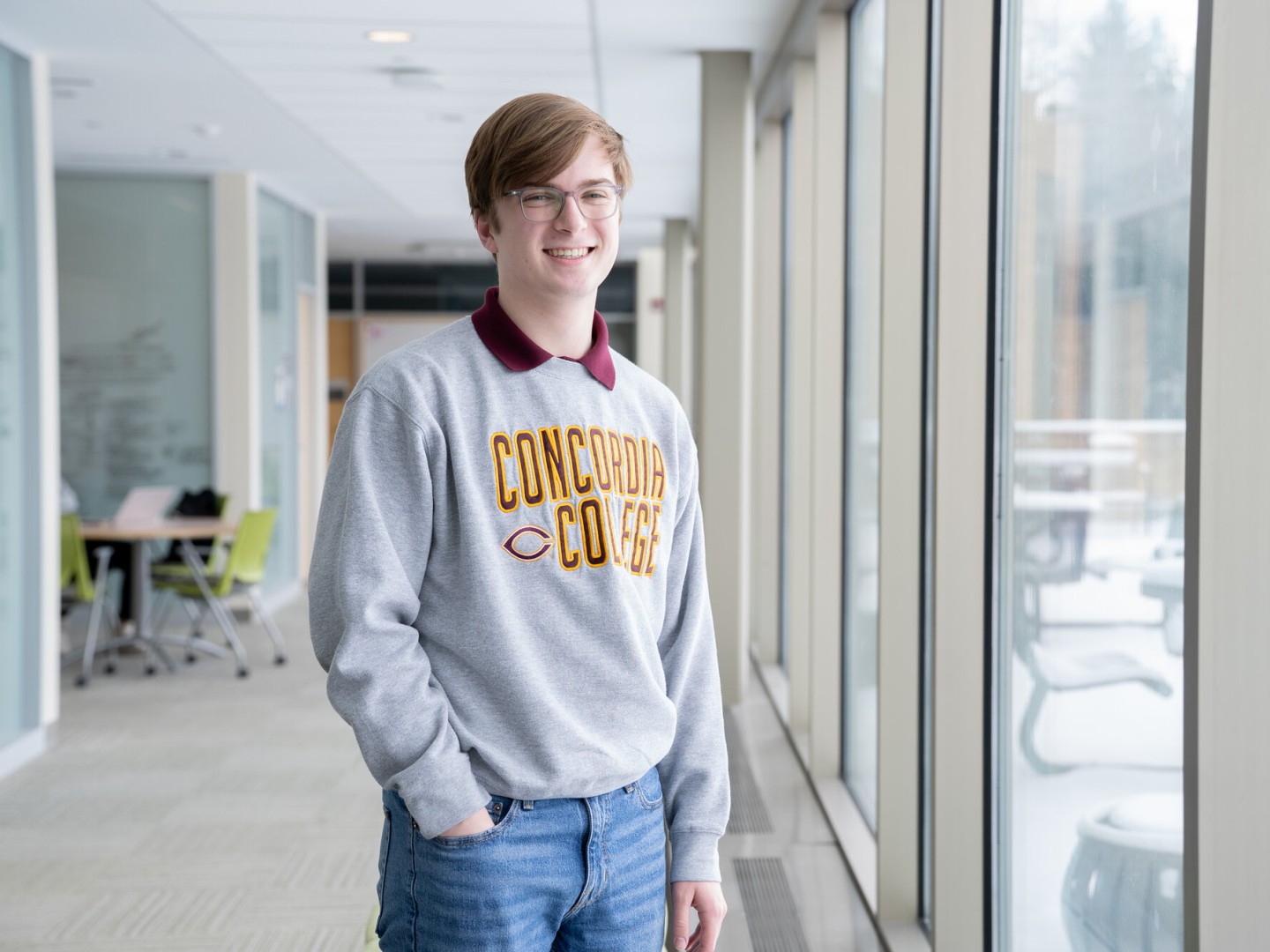
Jordon Perkins ’27 | Dawson, Minnesota
Majors: English Writing, Communication Studies
Minor: Interfaith Studies
Can you describe your summer research project?
As part of the English department’s summer research fellowship, I researched the genre of documentary poetry and was mentored by Dr. Vincent Reusch. Documentary poetry is a style where poets incorporate documents (like newspaper articles, video transcripts, etc.) into their poems to document and respond to a historical event.
I started the summer completing a literature review where I analyzed academic articles, documentary poetic collections, and other materials surrounding the genre. I found that documentary poetry rehumanizes those affected by dehumanizing documents, narratives, or events. I then compiled my findings into a paper and presentation, which I’ll present during the 2026 Celebration of Student Scholars (COSS) at Concordia and the Undergraduate Communication and English Conference at the University of St. Thomas in St. Paul, Minnesota.
Then, I began writing my own documentary poetic collection responding to the first 100 days of Donald Trump’s second term, which is informed by the methods and techniques I learned during my literature review.
What got you interested in the topic?
I was first introduced to documentary poetry as a form during my time in Chapel Choir last year. For our tour, Dr. Kemper encouraged members of the choir to search for or write readings and songs that we could submit for incorporation into the tour program, which focused on incarceration. It was difficult to find poems by incarcerated individuals but, in my search, I discovered the genre of documentary poetry. After doing some research on the genre, I decided to write a poem about Teofil Kosiński’s experience of incarceration during the Holocaust using quotes from his oral history testimonies.
I had really enjoyed both the processes of researching Kosiński’s experience and writing about it. So, later in the year when applications for the summer English fellowship opened, I decided to propose a project so I could delve deeper into and write more documentary poetry.
Do you have a favorite thing you’ve learned as a result of your research?
I’ve really enjoyed all the books I’ve read. “Olio” by Tyehimba Jess and “Whereas” by Layli Long Soldier have been two of my favorites. “Olio” was the first book I read for this project, so it holds a special place in my heart. Jess also had some fascinating experiments with form in this project that I’ve “borrowed” in my own work. Long Soldier’s poem “38” has become one of my favorite poems of all time. In “38,” she retells the narratives of the U.S.-Dakota War of 1862. Because this was an event that happened so close to where I grew up, it was interesting to see it discussed in a poetic format. “38” also definitely challenged some of the Eurocentric narratives surrounding the war I heard growing up.
I find this style of poetry cool because it engages with real-world social justice topics and does some pretty interesting things linguistically and stylistically.
Communication Research definitely gave me the research bug.
Do you have a favorite class you’ve taken at Concordia? A favorite professor?
I’ve really enjoyed Business Writing with Dr. Stephanie Lemmer and Fundamentals of Communication Research with Dr. Aileen Buslig. Both of these courses really gave me a lot of freedom in how I wanted to complete the assignments.
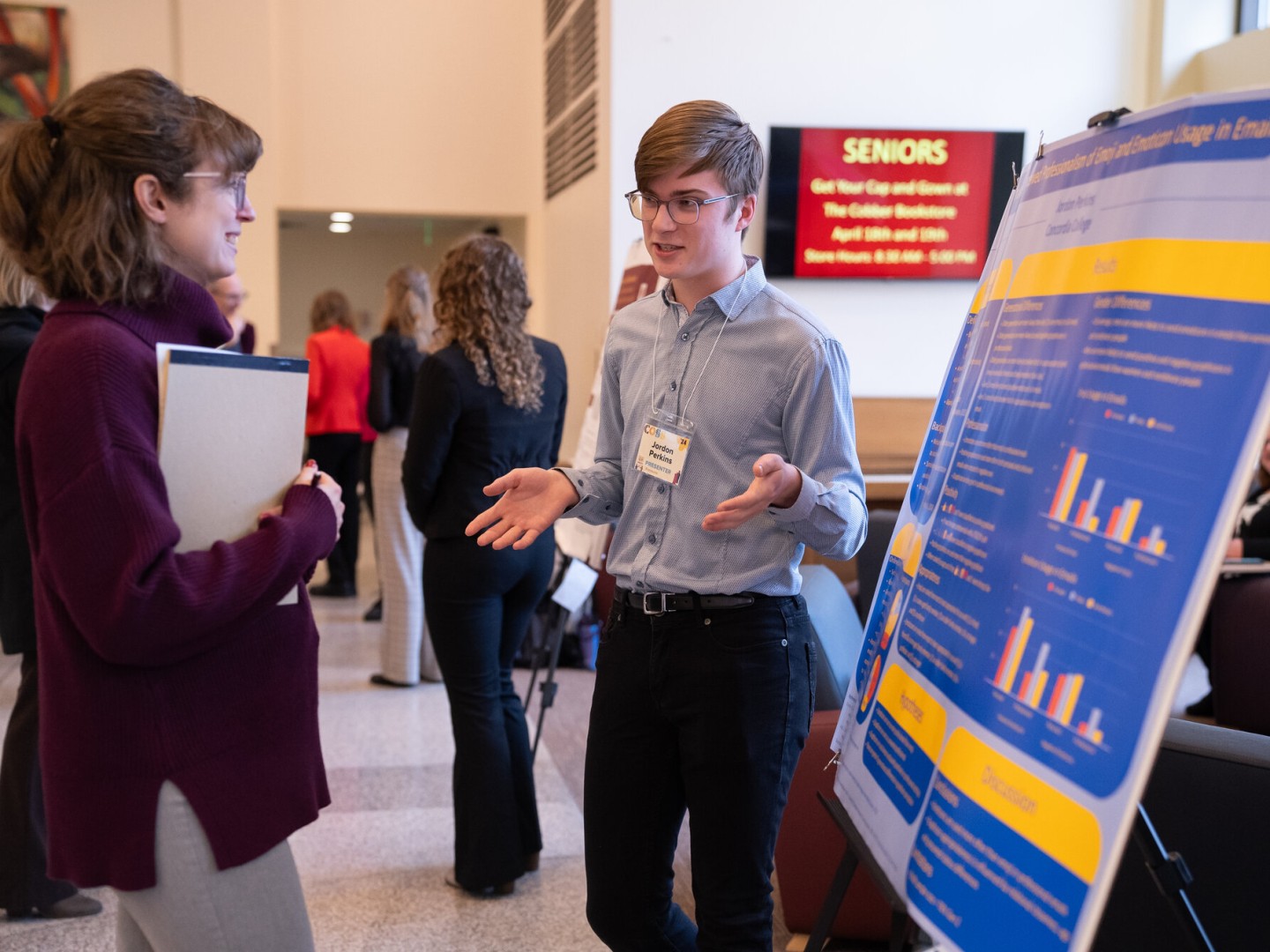
Communication Research definitely gave me the research bug. In this class, I was able to design and carry out my own study on the perceived professionalism of emoji and emoticons in email communication, and I presented my findings at COSS 2024. Having such a profound research experience during my first year has changed the way I approach research assignments in my other courses and helped me develop skills I’ve needed for this project.
Pertinent to this project, Business Writing taught me how to use Word as well as the basics of document design. My work in that class has also influenced how I choose to use fonts, spacing, and other stylistic pieces in my poetry.
Some of the most influential professors I’ve worked with have been Aileen, Dr. Lemmer, Dr. Kemper, and, of course, Vinny Reusch.
What made you choose to come to Concordia?
Concordia’s small class sizes definitely had a pull factor. I graduated from high school with a class of 43 people, so I knew that going to a larger university would have been a rough transition. Being in classes where I know my classmates and having professors who know my name has been so great in feeling integrated into the campus community.
Concordia’s choral program was also a draw. I knew that I wanted to continue singing during college. Being awarded a music scholarship helped me finance my time here, but it has also opened the doors to participation in some pretty cool experiences like the Christmas Concerts and last year’s Chapel Choir tour.
What extracurricular activities are you involved in?
I’m involved in The Concordia Choir, AfterWork, Lambda Pi Eta, Residence Life, and the Admission Office. Previously, I’ve also been involved in The Concordian, Handbell Choir, Vocal Jazz Maroon, and the RIDE Program, as well as working in the campus post office (shout out to Beth!).
You’re this year’s editor for AfterWork. In your opinion, why are student publications important?
I was excited to take on this position! As a person who has been published in AfterWork and written for The Concordian, student publishing has given me great opportunities to hone my writing in low-stakes environments. These publications also give students a voice that they otherwise wouldn’t have on campus.
I think that AfterWork, in particular, is a great encourager for students to create artistic projects on campus. Completing creative work can often be pushed aside during the academic hustle of the school year, but AfterWork gives students a chance to be lauded for their creative pursuits. It is also often the first place students publish work.
What do you love about being a Cobber?
I love telling people my mascot is corn! I also really appreciate Concordia’s culture of involvement. I feel that most people I meet are involved in multiple things on campus, which makes the community feel so much more engaging.
Do you have advice for students interested in student research?
If you’re interested in something, research it! I’ve found Concordia to be such a great place for student research because they work hard to include all disciplines and students. This past summer, URSCA held gatherings for all the students completing research or creative activity on campus, and it’s been so cool to hear about all the different things my peers are doing. Opportunities like COSS have given me some great and low-key opportunities to look deeper at the things I’m studying in my classes. Research is a lot less scary once you get into it!
Published March 2026