Chinese major Sean Martin ’25 shares how he adapts while honing his language skills in China.
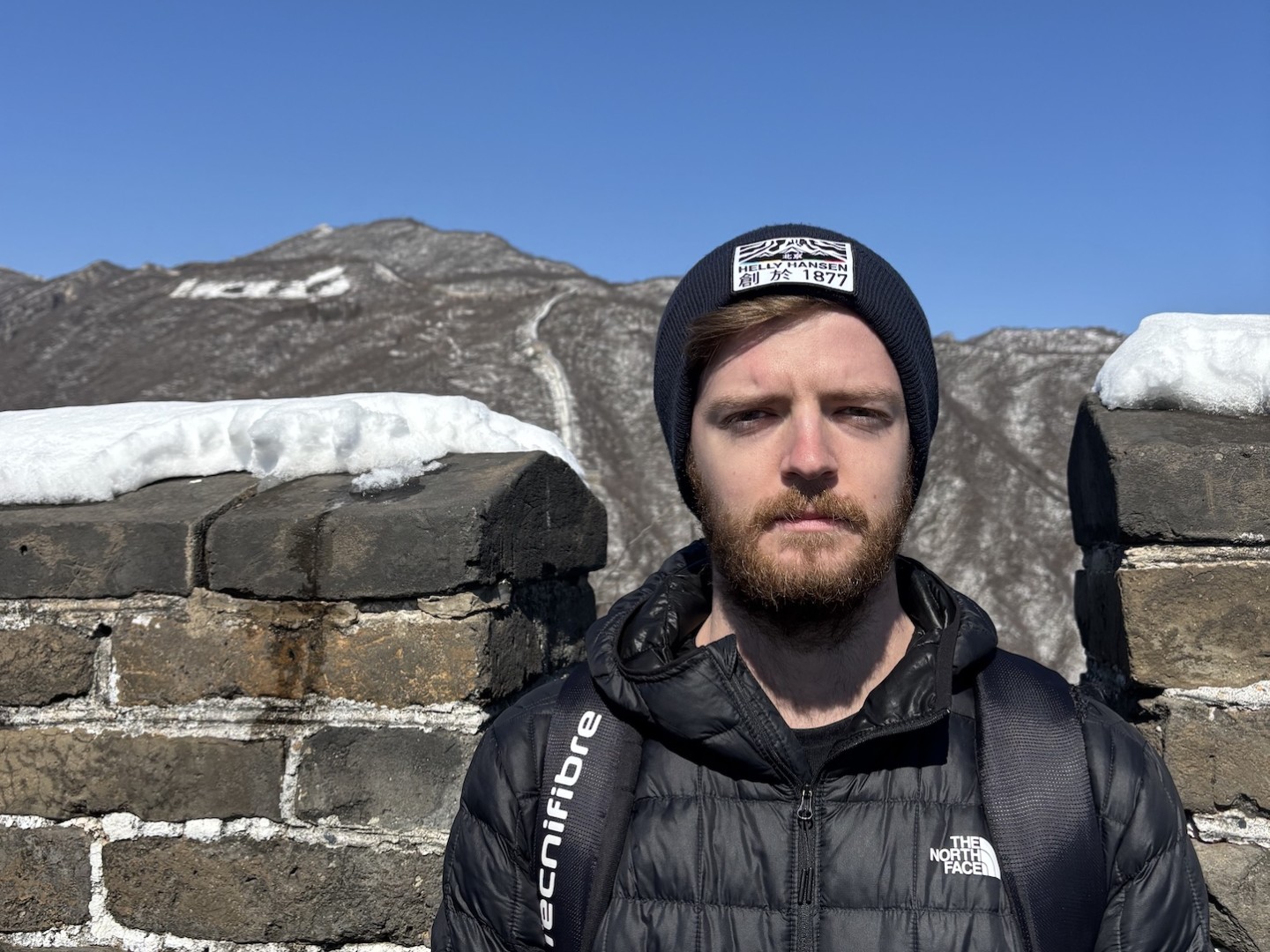
Sean Martin ’25
Currently Studying Chinese at Capital Normal University, Beijing
Major/Minor: Chinese Language and Cultures; Coaching
Please introduce yourself.
I graduated from Concordia in May 2025. I would’ve graduated in May 2024, but I took a fifth year, the Cobber Flex Year. I graduated with a major in Chinese language, culture, and history, and a minor in coaching.
Please share a little about your background and why you chose to study Chinese.
I’ve been studying Chinese since I was 12. My first Chinese class was in seventh grade, and I took it for two years to meet a middle school requirement.
During those two years, I had amazing teachers, and I took courses on Chinese history, language, culture, and related topics. I found them very fun, especially since Chinese came easier to me than other languages.
However, it had never occurred to me to major in Chinese in college or to move to China.
How long have you been in China, and how long do you plan to be here for?
I’ve been here a little over six months, but this is my fifth time being in China. It’s still to be determined how long I’ll be here, but I plan to study in China for the next two and a half to three years.
After completing my studies in Chinese language, I could stay here for as little or as long as I want, but I’m thinking three to four years. It depends on if I can find a job in China, but I do hope that I can increase my proficiency in the language and find a job that I like and fits my skill set.
Why did you decide to move to China to continue your education?
After graduating from Concordia, my Chinese level wasn’t where I wanted it to be. I told my parents that I’d work for the summer and then, in the fall of 2025, I would move to either Taiwan or China for a few years to continue studying Chinese.
What are you currently studying?
I’m studying in the Chinese language department, but I’m taking a wide range of classes — from Chinese language and poetry to Chinese business and public speaking. I’ve seen a lot of interesting correlations between the classes I’ve taken both here and at Concordia.
You have to adapt.
What skills do you think are the most necessary for your success, and how did Concordia contribute to those skills?
The number one thing as a foreign national in a foreign country is you have to adapt. You come to a new place where you have no idea what’s going to happen, what you’re going to do, or who you’re going to be friends with. And you can’t take anything for granted, no matter how small.
Regarding every situation, you have to adapt. This is my fifth time in China, but this is my first time in the north and in Beijing. There are a lot of things I had to adapt to really fast in order to be successful in where I’m at right now.
In terms of Concordia, the school is great. I learned adaptability, and I’m using the same skills now that I used at Concordia. I had a lot of independence from my professors in the Chinese program at Concordia, which was very helpful when moving across the world from the United States to Beijing, China. Otherwise, I probably would have struggled more.
What made you decide on Beijing to study Chinese?
Dr. Jiani Jiang, who I had for Marketing and Sales during my last semester at Concordia, was a huge contributing factor in my decision to move to Beijing and continue my studies here.
She told me about a school in Beijing that she has connections with, so I decided to let Dr. Jiang help me out instead of going through the hassle of looking at different colleges and the college application process in China because it’s very troublesome for international students due to the lack of timely responses.
Also, I’d never been to the north. I’d always been to the south in China, so this would be a good test of my adaptability.
Finally, my girlfriend, who is from Honduras, goes to school in Tianjin, which is a 30-minute bullet train ride southeast of Beijing, so I would be relatively close to her and be able to see her more often.
What are your future plans or career goals?
In terms of career goals, I just want to be successful in my own way and be content and be proud of what I’ve done and the achievements that I’ve accomplished.
I’m not striving for a specific field like banking, finance, accounting, or international business. I’m working on a number of side projects right now. However, with at least two and a half years left until the end of my program, I still have a lot of time to prepare.
My current goal right now is to improve my HSK level (Chinese language proficiency exam) from my current level of 4 to a level 5 or 6. At that point, I will be able to work any job in China, regardless of the city, which would open up a lot of doors for me.
To achieve that goal, I’m working on my pronunciation, my reading level, on gaining a vast knowledge of Chinese characters, and to become as fluent as I possibly can. When I get to a level where I’m very content and happy, then I think I’ll be very successful.
What are some challenges that you have faced since graduating, and how did you overcome them?
Whether it was finding jobs in Atlanta, Georgia, or Charlotte, North Carolina, before traveling, the job market for college graduates is challenging. Ever since COVID happened, and with AI, I would say, finding jobs has been difficult.
Another difficult thing that I’ve mentioned is adaptability. I’ve been studying basically my whole life — elementary school, middle school, high school, college, and then, suddenly, it ended. I was no longer a student and no longer a student-athlete. It was a weird transition in my life, so I tried to figure out things that made me passionate and were inspirational, just to keep me moving forward.
Another challenge after graduation was the next steps. My siblings both work in Denver and have full-time jobs, making a lot of money. That happened within a few months after their graduation, but I was going back to school on the other side of the world. That was really tough for me. I didn’t finish my five-year plan until about a week before leaving for China because I wasn’t sure what possibilities could wait for me in the next few years when I was on the other side of the world.
Why did you choose Concordia?
In my senior year of high school, I applied to four colleges across the United States, and each offered Chinese language as a major and not just a minor. At the time, Concordia’s Chinese program was very strong, so I applied.
However, during my freshman year at Concordia, COVID hit, and many of the professors in the Chinese program left. The department wasn’t what I expected it to be, but I didn’t want to transfer. I wanted to stay in the place that I chose and make the best of it. I wanted to use what I had to make myself into my own successful being, which I think built a lot of character.
If I didn’t go to Concordia, I probably wouldn’t be in the situation I am right now in China. I most likely would not have met my girlfriend, who I met when I was in Taiwan. And I wouldn’t have met the people, the classmates, the students, and my friends at Concordia. Regardless, I would still choose Concordia over a school that could’ve given me a better scholarship or had a better program.
Perhaps the Chinese program wasn’t as good as when I started, but traveling around the world and living in a different country on the other side of the world, when people ask where I graduated from, I say, Concordia College. They do not know the college, but they regard Concordia as a high standard because it produces students like myself, who have exceeded the average rate of a United States citizen speaking a foreign language.
What activities were you involved in at Concordia?
I was the treasurer of the Chinese Club for a couple of years, which was really fun. And I was a student-athlete on the Cobber tennis team for my entire time at Concordia. I was very engaged across campus, participating in different club activities and sporting events.
Can you talk about your Peak experiences while you were at Concordia?
At Concordia, you have to do two Peak experiences to graduate. I had heard that Peaks were very fun and straightforward. I think I was a special case because I disliked my Peak experience.
During my junior year, I studied abroad in Taiwan for 12 months, and it was supposed to count for both of my Peaks. However, something went wrong with the credit transfer between Concordia and the school in Taiwan, so I didn’t get credit for my Peaks during my study abroad trip, which was very inconvenient.
When I came back to Concordia for my senior year, I had to write four different papers regarding my time in Taiwan, and I didn’t like that because I had to write these papers four months afterward, so I couldn’t remember too much. Also, it was during the academic semester, which added to the other papers and assignments I had to do for my classes.
Do you have a favorite professor and course?
I don’t have a singular favorite professor; I have multiple. I’m not going to name all of them, but there’s a good handful at Concordia that played a part in my success.
My favorite course at Concordia was my First-Year Seminar (FYS), which I took as a freshman in 2020. It was The Samurai: Myth, Legend, and History and was taught by Dr. Elijah Bender.
The class was on East Asian history, with a focus on Japan, and how Japan was a very world-dominant country back in the day, before China became what it is today. I thought it was a very interesting class. And taking that class as a freshman, I remember thinking, “Dang, that’s really cool.” It left a really good impression on me for the next four years.
Do you have any mentors at Concordia who were influential to you during your time in college or are still influential?
I’m not in touch with my academic advisor or the professors that I had during my years at Concordia, but when I was there, the professors who were mentors to me when I was a student at Concordia still influence me.
Definitely Dr. Elijah Bender. He was a very good mentor, just talking to him about East Asia. He had a really big passion for it, studied there, and had spent some time there as well. So we traded thoughts and experiences, which was really fun. He told me about the things that might work out and might not work out for me, in terms of business ideas. He’s been a really big help to me.
And Dr. Jiang in the Offutt School of Business. I never knew her up until my last semester at Concordia. I took a class with her and started talking to her. Because she’s a Chinese national, she gave me a lot of insight about the country itself, especially the business aspects. I didn’t know a lot about business, and she has really helped me a lot with that. My experience in China would be a lot different if she hadn’t helped me, so I owe a lot to her because she played a part in the success I have right now. If it were not for her, I would still be struggling in China.
And, of course, the world languages and cultures department, specifically the Chinese program. They are all very talented individuals in what they do and how they say things, so I appreciate all of them.
What advice would you give to a current student or someone who is considering Concordia?
I’ll answer both of them separately.
To someone who is considering Concordia, there are a lot of great universities and colleges in the United States and around the world, so I can’t say Concordia is the best fit for everyone. But if you choose Concordia, it’s a school that will teach you how to be successful on your own. And success is different for everybody. You can make a lot of money after you graduate. You will have a lot of connections through networking. With hard work, Concordia will definitely help you be successful. It’s a small, private school, so I think the best part about Concordia is that it’s almost one-on-one between you and the professor. I personally think that it’s a perfect real-world experience because, when you graduate, you’re on your own. And I think that is a really good skill to have from the start, even as a freshman in college.
To someone who is currently at Concordia, I would say, regardless of what major or department you’re in, how many classes you’re taking or the credits you have, use the support system that you have currently. Go to office hours, email your professors constantly to annoy them about upcoming assignments, or whatever else, because you definitely need all the experience you can get as someone who still has time to learn before you graduate and enter the world where you spend all your time doing that job. Because if you’re learning how to do your job while working, it’s not going to be a fun time because it will be a lot of stress.
Also, take different classes in different departments, especially if you have time and spare credits, because it’s a liberal arts school. When you graduate, having an all-around academic base, not just a focused study in your major, will be really good for you because you can go into any environment and be successful.
Photos and interview by Lauren Strand ’26
Published June 2026